
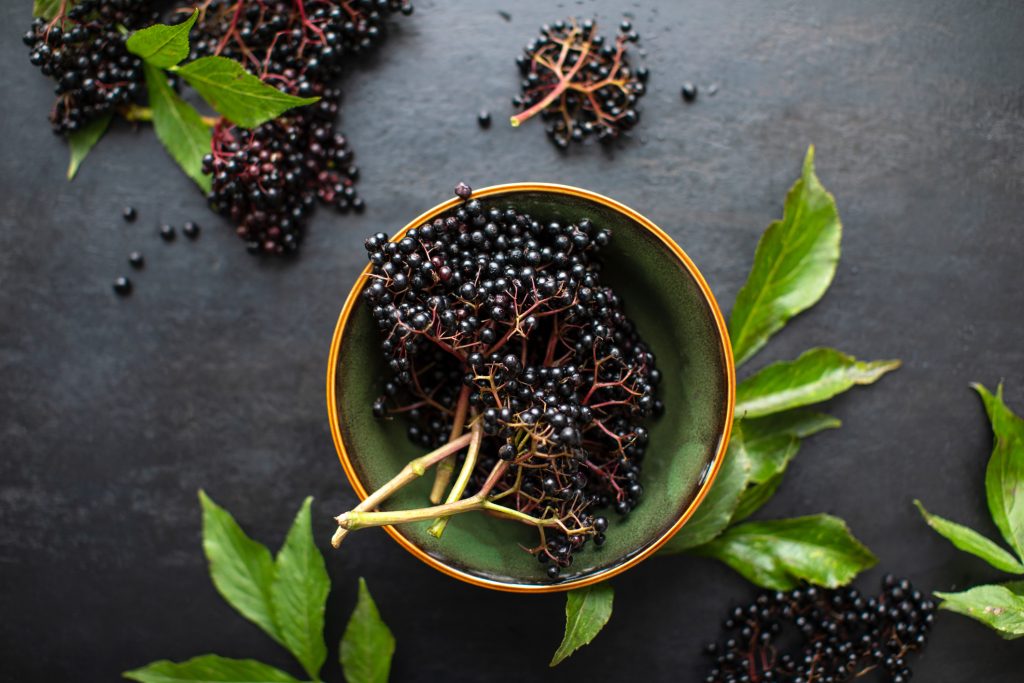
For centuries, elderberries were gathered from hedgerows and turned into homemade syrups, cordials and preserves. Today, this tiny purple fruit sits at the centre of a booming wellness market and a growing body of scientific research. So why are we suddenly so interested in something our grandmothers knew about generations ago?
Long before anyone talked about functional foods, antioxidants or immune health, elderberries were being gathered and cooked in kitchens across Europe. The dark purple fruit of Sambucus nigra, the European black elder, has been used in traditional food and herbal preparations for generations, made into everything from syrups and cordials to jams, wines and seasonal tonics. It was knowledge that tended to be passed down rather than packaged up: knowing when the berries were ready, how to prepare them and what else to combine them with. Yet somewhere along the way, as medicine became more sophisticated and our food increasingly industrialised, many of these domestic traditions slipped quietly out of everyday life. Now they are returning, and elderberry in particular has found itself recast as one of the stars of the modern wellness world.
Walk through a health-food shop today and you are likely to find elderberry in an extraordinary number of forms: syrups, gummies, capsules, powders, teas, lozenges and wellness shots. The pandemic accelerated interest dramatically, with US elderberry supplement sales running into hundreds of millions of dollars during the height of consumer demand. What is particularly interesting, however, is that science has also become increasingly curious about a fruit that traditional cultures were using long before anyone could identify the compounds inside it. Elderberries contain vitamin C and fibre, but much of the scientific attention centres on their high concentration of polyphenols, including anthocyanins, the naturally occurring plant pigments responsible for that intense purple-black colour. Anthocyanins are being studied widely for their antioxidant and biological activity, and elderberry happens to be a particularly interesting source of them.
That doesn’t mean, however, that a spoonful of elderberry syrup is a scientifically proven way of avoiding the winter cold. This is where the story becomes more interesting than much of the wellness marketing surrounding it. Studies investigating elderberry and respiratory infections have produced intriguing but mixed results. Some research has suggested certain elderberry preparations may help with the duration or severity of upper respiratory symptoms, while other studies have failed to demonstrate a significant effect. Major health authorities therefore remain cautious: there simply isn’t enough high-quality clinical evidence to say that elderberry prevents or cures colds, flu or other illnesses. It is an important distinction. Traditional use can provide scientists with fascinating questions to investigate, but centuries of use are not in themselves clinical proof.
Perhaps elderberry doesn’t need miraculous claims to make it interesting. At a time when consumers are increasingly questioning highly processed products, reading ingredient labels and wanting to understand where things come from, the return to plants such as elderberry says something rather interesting about how our relationship with food and wellbeing is changing. We are embracing extraordinary advances in technology and medicine while, simultaneously, looking backwards towards fermentation, foraging, seasonal eating, herbs and preparations our ancestors would have recognised instantly. Somewhere between those two worlds lies a rapidly growing generation of small food and wellness businesses, and two British female founders illustrate particularly well how an ancient ingredient can be reinvented without losing the story behind it.
For Sophie Burrows, founder of Nurtured Organics, the journey began not with a business plan, but with her daughter starting nursery. Suddenly it seemed as though the family was dealing with one bug after another, something many parents of young children will recognise immediately. Burrows began looking for something simple and natural that she could incorporate into family life and found herself drawn to the traditional use of elderberries. She wanted recognisable ingredients and didn’t want refined sugar or a long list of unnecessary additives, so she began making her own blend at home using organic elderberries, raw honey and warming spices. It became a family ritual, then friends and relatives began asking for it, and gradually an idea that had begun in her own kitchen turned into a business. Today Nurtured Organics makes its products by hand in small batches in Britain, and Burrows is looking towards the next stage of growth, including introducing the range to independent retailers that share her approach to ingredients and provenance.
There is something particularly interesting about businesses that begin this way. We hear so much about entrepreneurs identifying a “gap in the market”, yet many successful independent brands start with something far less calculated: somebody simply cannot find what they want. The customer becomes the maker, and the maker eventually becomes the founder. That gives the resulting business a very different sort of authenticity because the original customer is sitting at the heart of it. Burrows wasn’t initially trying to capture a piece of a growing elderberry market; she was making something she wanted for her own family. Only when other people began wanting it too did the commercial possibility start to emerge.
For Olenia Smart, founder of Bloomfield Botanicals, the route to the same dark purple berry could hardly have been more different. Smart grew up foraging in the forests of Poland, where plants, berries and seasonal ingredients were part of ordinary family life. Nature was not something packaged and sold as wellness; it was simply where ingredients came from. Knowledge about what was growing, when to gather it and how it could be prepared was absorbed through childhood and remained with her long after she moved away. Years later in Bath, those early experiences became the foundations for Bloomfield Botanicals. Smart now handcrafts botanical products in small batches using certified organic elderberries, raw honey and ingredients including rosehips and elderflower, bringing the traditions and memories of her Polish childhood into a contemporary British wellness business.
Put the two founders beside one another and there is a wonderful contradiction. They are working with the same central ingredient and operating within the same growing market, yet the reasons they arrived there are completely different. One story begins with a young mother trying to find something for her family; the other begins decades earlier with a little girl foraging in Polish forests. Neither started with a trend report announcing that elderberry was about to become fashionable. Their businesses grew out of their lives, which perhaps explains something about why founder-led brands have become so compelling to consumers. When we buy from a small business, increasingly we are not simply buying what is inside the bottle. We are buying into provenance, knowledge, values and the human being who decided the product needed to exist in the first place.
There is another reason these businesses feel particularly relevant now. The wellness industry has spent years pursuing the new: the newest supplement, the latest superfood, the next biohack, the ingredient most of us cannot pronounce. Yet some of the most interesting trends in contemporary health and food are taking us in precisely the opposite direction. Fermented foods, medicinal mushrooms, bone broth, sourdough, herbal preparations, foraging and seasonal eating are hardly inventions of the twenty-first century. They are old ideas being examined through a modern lens. Elderberry sits perfectly within that movement, with scientists using sophisticated analytical techniques to examine the chemistry of a fruit that families were picking from hedgerows centuries ago.
There are sensible reasons for caution, too. “Natural” is not synonymous with harmless, just as “traditional” does not automatically mean scientifically proven. Raw or unripe elderberries and certain other parts of the elder plant contain compounds capable of releasing cyanide and can cause nausea, vomiting and diarrhoea if consumed improperly, which is why elderberries need appropriate preparation. Nor should an elderberry product be regarded as a substitute for medical treatment. Those caveats matter, particularly in a wellness market in which attractive claims can sometimes travel considerably faster than the evidence supporting them. In many ways, acknowledging what science does not yet know makes the genuine research around the plant far more interesting.
Perhaps that is ultimately why the elderberry story feels so timely. It sits at the intersection of several things we are increasingly interested in: science and tradition, nature and commerce, provenance and modern wellness. There is still much researchers don’t know about its potential effects on human health, but there is no question that this small, almost-black berry contains a fascinating mixture of plant compounds or that its relationship with humans stretches back generations. What was once gathered from the hedgerow and made in family kitchens has become the subject of laboratory research and a rapidly expanding international market.
For Sophie Burrows and Olenia Smart, however, the story remains much more personal. One discovered an old tradition while looking for something for her daughter; the other carried that tradition with her from childhood. From those two beginnings have emerged Nurtured Organics and Bloomfield Botanicals, two very different British businesses built around the same ancient fruit.
One berry, two women and two completely different stories. Perhaps the most interesting thing about the revival of elderberry isn’t simply what science eventually discovers about it, but why, after all these years, we are finding our way back to it.