
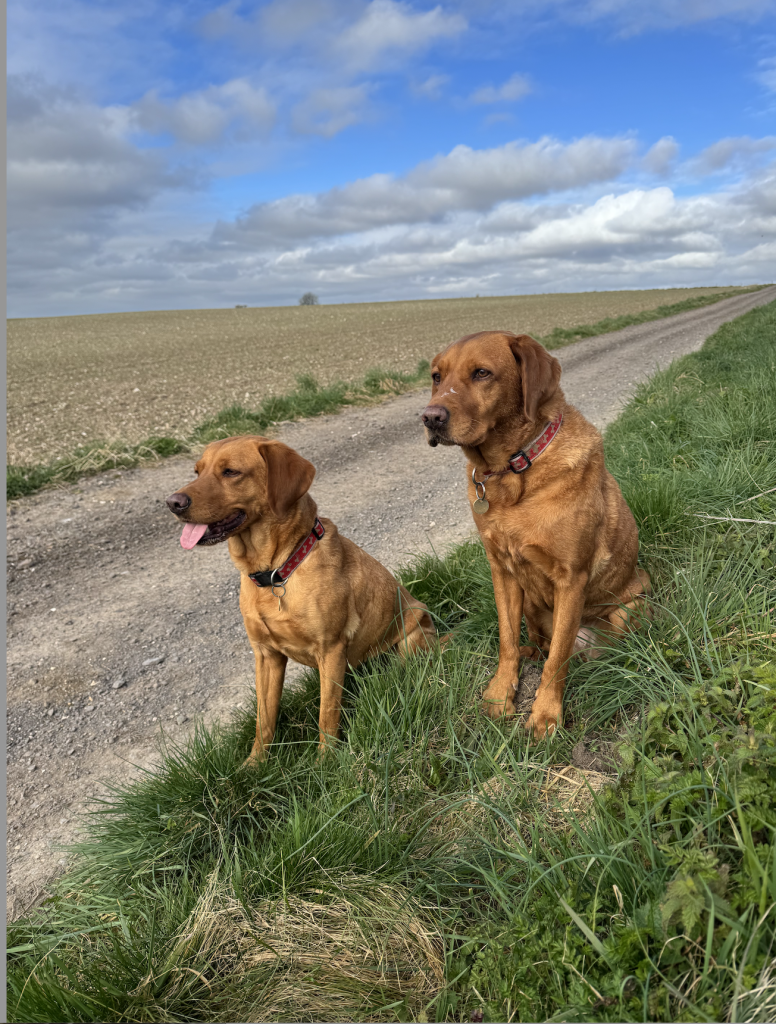
I absolutely love my morning walks, out in the fresh air and the morning sunlight, whatever the sky is doing. The dogs make sure of it. They sit by the door, watching me, making it quite clear that the walk is happening, and there is really no getting out of it. There are plenty of mornings when part of me would rather not go. It is raining, it is cold and damp, I am on a tight timescale, or I am desperate to get back and get on with something. And yet the moment I am out, the energy of the whole day changes.
I notice it even more when, for whatever reason, I haven’t been out with them. The difference is extraordinary. The day never quite gets going. I feel flatter and foggier, and I find myself reaching for another coffee to do the job the walk would have done for free. I think most of us have felt this without ever really knowing why. So I went looking.
A plant in a cupboard
It turns out the story begins with a plant in a cupboard. In 1729, a French astronomer called Jean-Jacques d’Ortous de Mairan was intrigued by the mimosa, whose leaves open towards the sun in the day and close at dusk. Everyone assumed the plant was simply reacting to the light. De Mairan shut it away in total darkness, and the leaves carried on opening and closing to their own daily rhythm. The plant, it seemed, kept its own time.
It was more than two hundred years before the idea had a name. In 1959, Franz Halberg at the University of Minnesota coined the word circadian, from the Latin circa, meaning about, and dies, meaning day. Our circadian rhythm is quite literally our about a day rhythm: an internal clock that runs to roughly, but not exactly, 24 hours.
Two months in a cave
My favourite story from this history belongs to Michel Siffre. In July 1962, this 23 year old French geologist climbed 130 metres down into a glacial cave in the Alps and lived there for two months with no clock, no calendar and no daylight. When his team called down in mid September to tell him it was over, he didn’t believe them. By his own reckoning it was around 20 August, and he thought he still had nearly a month to go. Without the sun to set it, his sense of time had simply drifted away.
How morning sunlight sets our body clock
That is exactly what daylight does for us. Our clock keeps running without it, but it needs light each day to keep it in step with the real world. In 2002, David Berson and his team at Brown University found out how. They discovered a special kind of cell in the eye, separate from the ones we use to see, which senses brightness and sends signals straight to the clock in the brain. Then in 2017, the Nobel Prize in Physiology or Medicine went to Jeffrey Hall, Michael Rosbash and Michael Young for uncovering how the clock itself works inside our cells, governing our sleep, hormones, body temperature and metabolism.
So what does it actually mean on a damp November morning? When daylight reaches our eyes, it tells that master clock the day has begun. Melatonin, the hormone that makes us sleepy, is switched off, and a timer is set for it to rise again that evening. Cortisol rises to help us feel awake and alert. Dr Rangan Chatterjee put it beautifully in his newsletter this week: by changing small things in our day, we change our biology without even having to think about it. That, I now realise, is why the energy shifts the moment I am out of the door.
What the research tells us
One piece of research I love comes from Professor Kenneth Wright at the University of Colorado Boulder. In 2013 he sent eight volunteers camping in the Rocky Mountains for a week, with no torches or phones, just the sun and a campfire. By the end of the week every one of their body clocks had fallen into step with sunrise and sunset, night owls included. A later study found that even a single weekend of camping brought the evening rise of melatonin forward by nearly an hour and a half. Small studies, but they show how quickly our clocks respond to proper daylight, and how much our indoor lives push them later.
Closer to home, a team led by Angus Burns at Monash University looked at more than 400,000 people in the UK Biobank. Those who spent more time in outdoor daylight reported better mood and better sleep, and found it easier to get up in the morning. A later study, in which over 85,000 people wore light sensors, linked more daytime light with a lower risk of depression. This kind of research shows a link rather than proof, and people who feel well may simply find it easier to get outside. Even so, the pattern is hard to ignore.
What surprised me most is how little light we get indoors, even when it doesn’t feel dark. Light is measured in lux. Researchers at Aarhus University gave light sensors to around 500 workers and found that indoor workers received roughly 400 lux during the working day in winter, while outdoor workers averaged 1,000 to 2,000 lux. Full daylight is around 10,000. So even the greyest morning outside gives our body clock far more to work with than a well lit kitchen. All those wet walks I nearly talked myself out of were doing their job all along.
Credit where it’s due: the dogs
And the dogs deserve their share of the credit. A University of Liverpool study led by Dr Carri Westgarth surveyed 385 households in West Cheshire and found that dog owners were four times more likely to meet the recommended 150 minutes of activity a week. The dog walking came on top of their other exercise, not instead of it, and dog owners were more willing to head out in bad weather, which in Britain is no small thing.
Not everyone has two dogs waiting by the door, of course, and this is where routine comes in. James Clear, in Atomic Habits, calls it habit stacking: attaching something new to something you already do, so it happens without relying on willpower. Your first cup of tea taken into the garden. The phone call you would have made anyway, made while walking round the block. Part of the school run on foot. Curtains and windows flung open the moment you are up, and a minute on the doorstep while the kettle boils. And be patient with yourself. Phillippa Lally and her colleagues at UCL found it took a median of 66 days for a new daily habit to feel automatic, and that missing the odd day made little difference. It is coming back to it that counts.
The other half of the story is the evening. If bright mornings tell our bodies the day has started, dim evenings tell them it is ending. Softer lamps, phones on their night setting and some time away from screens before bed all help the clock do its job.
Why morning sunlight is priceless
None of this costs a penny. No app, no equipment, no membership. Just the door, a few minutes and the sky, however grey it happens to be. If you can do it, it is priceless.
Perhaps this week we could each try one small thing. Take your first cup of tea outside. Walk to the end of the road and back before opening the laptop. Open the window and breathe it in.
As for me, the dogs will be sitting by the door again tomorrow morning, whatever the weather. I am very glad they will be.
If you enjoyed this, you might also like Why Sleep Is the Most Underrated Form of Self Care (And What Magnesium Actually Does) and Why Walking Matters More Than Ever.